Leftover rice gets treated like any other leftover — cooled on the counter, then put away whenever there’s time. But rice behaves a little differently from most cooked foods, and the way it’s cooled matters more than people usually assume. This isn’t about rice being unusually risky; it’s about a few extra minutes at the wrong stage making a bigger difference than with other leftovers.
This article is for general informational purposes only and reflects commonly recommended food handling practices, not medical or professional food-safety advice.
Why Rice Is Treated a Little Differently
Uncooked rice can naturally carry spores that survive cooking. These spores aren’t a concern while rice is hot, but if cooked rice is left at room temperature for an extended period, conditions can become favorable for them to become active. This is the main reason food safety guidance generally treats rice with a bit more urgency than, say, leftover vegetables.
Step 1: Cool It Faster Than You Think You Need To
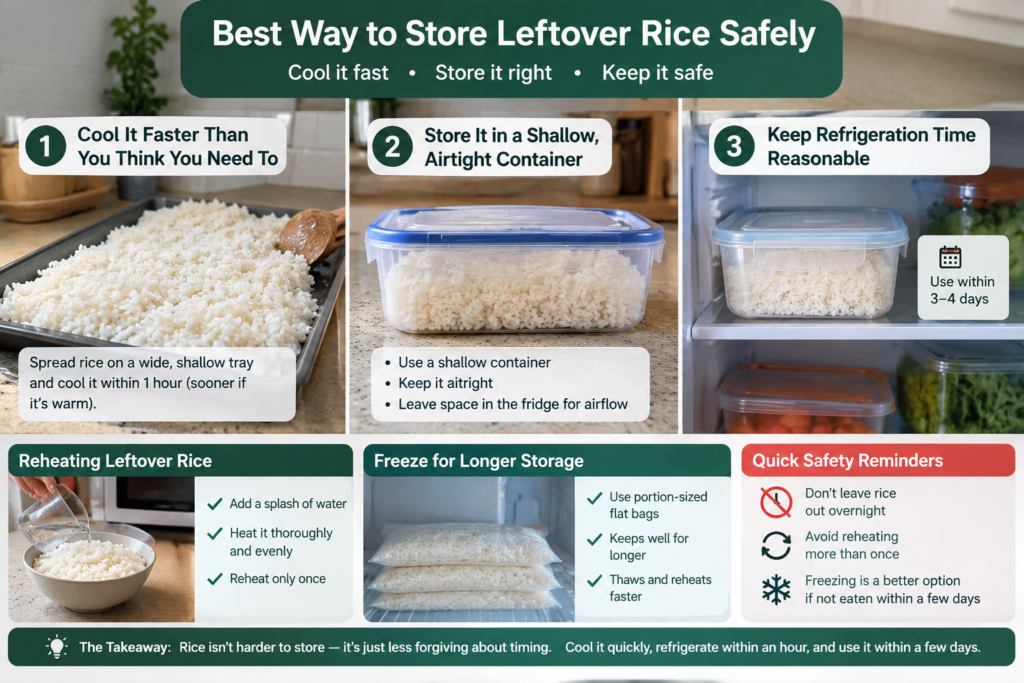
The general recommendation is to avoid leaving cooked rice at room temperature for more than about an hour before refrigerating it — sooner if the kitchen is warm. Spreading rice out on a wide, shallow tray rather than leaving it in a deep pot helps it cool more evenly and quickly, since a large mass of rice retains heat longer in the center.
Step 2: Store It in a Shallow, Airtight Container
- Shallow containers cool rice faster and more evenly than tall, deep ones.
- An airtight lid limits moisture loss and reduces exposure to airborne contaminants.
- Avoid stacking hot containers directly on top of other fridge items — leave a little space for airflow until it’s fully cooled.
Step 3: Keep Refrigeration Time Reasonable
Most general food safety guidance suggests using refrigerated cooked rice within about 3 to 4 days. Beyond that window, quality and safety both start to decline, even if the rice still looks and smells fine — which, as with most cooked foods, isn’t a reliable indicator on its own.
Reheating Leftover Rice Properly
When reheating, the goal is to heat it thoroughly and evenly, not just warm the surface. Adding a splash of water before microwaving or pan-heating helps distribute heat more evenly through the rice. Reheating only once, rather than repeatedly, is generally the safer approach for any refrigerated cooked rice.
Can You Freeze Leftover Rice Instead?
Yes — freezing is often a better option if the rice won’t be eaten within a few days. Portioning it into flat, sealed freezer bags before freezing makes it quicker to thaw and reheat later, and generally extends how long it stays good compared to refrigeration alone.
Frequently Asked Questions
Is it safe to eat rice left out overnight?
Generally, no — rice left at room temperature for several hours or overnight falls well outside the commonly recommended safe window and is typically best discarded.
Can you reheat rice more than once?
It’s generally recommended to reheat rice only once. Repeated cooling and reheating increases the amount of time it spends at less favorable temperatures.
Does freezing rice change its texture?
Slightly — rice can turn a bit firmer after freezing and reheating, though this is usually a texture difference rather than a safety concern.
The Takeaway
Rice isn’t harder to store than other leftovers — it’s just less forgiving about timing. Cooling it quickly, refrigerating within about an hour, and using it within a few days covers most of what commonly recommended food safety guidance suggests.
Related Reading
- For the full picture on leftovers in general, see our guide on How to Store Food Safely at Home.
- Wondering about timing for other foods too? Read How Long Can Cooked Food Stay at Room Temperature.
- Browse more in our Food Safety and Quality Management category.