You cooked dinner, got distracted, and now you’re staring at a pot that’s been sitting on the counter for a while — is it still fine to eat? This is one of the most common food safety questions, and the answer isn’t about how the food looks or smells. It’s about time and temperature, two things that don’t show up visually until it’s often too late.
This article is for general informational purposes only and isn’t a substitute for professional food safety or medical advice. When in doubt about a specific food or situation, it’s best to err on the side of caution.
The General Guideline Most Food Safety Sources Follow
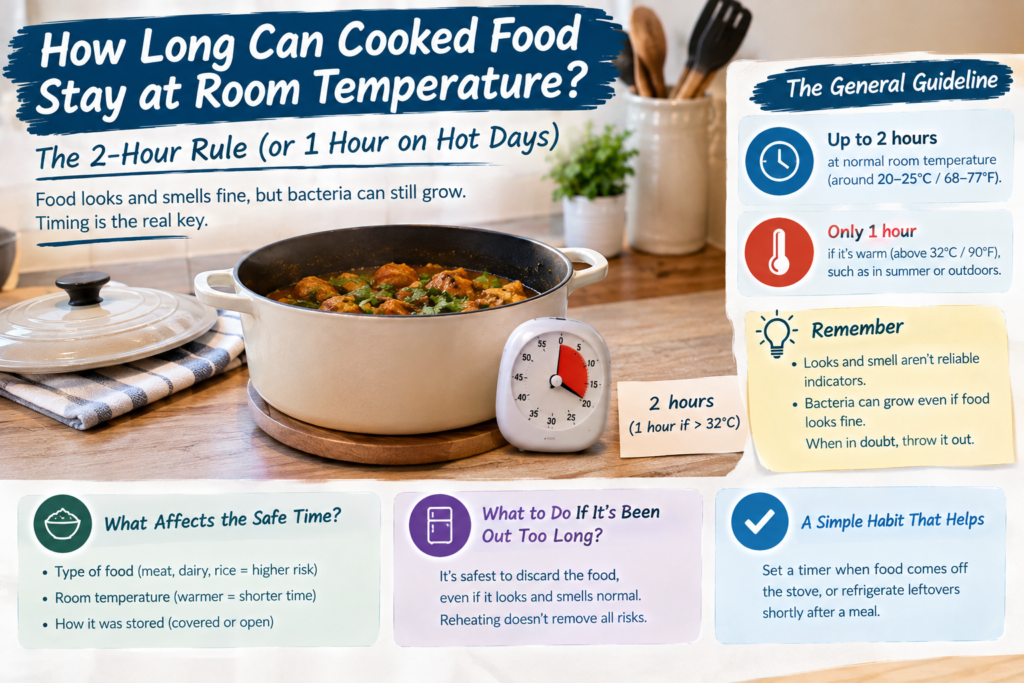
Most food safety organizations recommend not leaving cooked food at room temperature for more than 2 hours. If the room is particularly warm — above roughly 32°C (90°F), such as during summer or an outdoor gathering — that window generally shortens to about 1 hour. This isn’t an arbitrary number; it reflects how quickly bacteria tend to multiply once food drops out of properly hot or properly cold temperature ranges.
Why Looks and Smell Aren’t Reliable Indicators
One of the more common misunderstandings is assuming food is safe as long as it looks and smells normal. Many of the bacteria responsible for foodborne illness don’t change the appearance, texture, or smell of food at all in the early stages. This is exactly why relying on timing, rather than a visual check, is considered the safer approach.
What Changes the Safe Time Window
- Type of food: Rice, dairy-based dishes, and foods with meat, poultry, or seafood are generally considered more time-sensitive than dry or acidic foods.
- Room temperature: Warmer environments shrink the safe window, while cooler, air-conditioned rooms may allow slightly more buffer — though the 2-hour guideline is still the commonly recommended default.
- How the food was stored before serving: Food left in a covered pot retains heat differently than food spread out on an open plate, which can affect how quickly it cools into the temperature range where bacteria multiply fastest.
What to Do If Food Has Been Out Too Long
When in doubt, the generally recommended approach is to discard food that has been left out beyond the safe window, rather than relying on a smell or taste test. This can feel wasteful, but it’s the approach most food safety guidance points to, since the risk of foodborne illness isn’t easy to reverse once it happens.
A Simple Habit That Helps
Setting a rough mental timer when food comes off the stove — or refrigerating leftovers shortly after a meal rather than leaving them out “for later” — removes the guesswork entirely. It’s a small habit, but it consistently shows up in food safety guidance as one of the easiest ways to reduce risk at home.
Frequently Asked Questions
Is it safe to eat food left out overnight?
Generally, no — food left out for several hours, let alone overnight, is well beyond the commonly recommended 2-hour window and is typically not considered safe to eat.
Does reheating make food safe again after sitting out too long?
Reheating can kill some bacteria, but it doesn’t reliably remove toxins that certain bacteria may have already produced while the food was sitting out. This is why timing matters more than reheating as a fix.
Does covering food help it stay safe longer at room temperature?
Covering food mainly protects it from contamination (dust, insects) rather than extending the safe time window — the 2-hour guideline still generally applies whether the food is covered or not.
The Takeaway
The safest approach is a simple one: treat 2 hours as the general cutoff for cooked food at room temperature, and 1 hour on especially warm days. Since appearance and smell aren’t reliable warning signs, timing is the one factor worth actually keeping track of.
Related Reading
- For a full home food storage checklist, see our guide on Food Safety and Quality Management.
- Storing fruits and vegetables has its own set of rules — browse our Fruits & Vegetables guides.