The term “ultra-processed” gets thrown around a lot these days, but most people have never actually flipped a package over and used it to make a real decision. The good news is you don’t need a food science degree to spot the warning signs — a few consistent patterns show up again and again once you know what to look for.
This article is for general information only and isn’t medical advice. Dietary needs vary from person to person, so speak with a doctor or dietitian if you have specific health concerns.
Start With the Ingredients List, Not the Front of the Pack
Front-of-pack marketing — words like “natural,” “wholesome,” or “made with real fruit” — often has little connection to how processed a product actually is. The ingredients list on the back tells a far more honest story, and it’s the first place worth checking rather than trusting the packaging design.
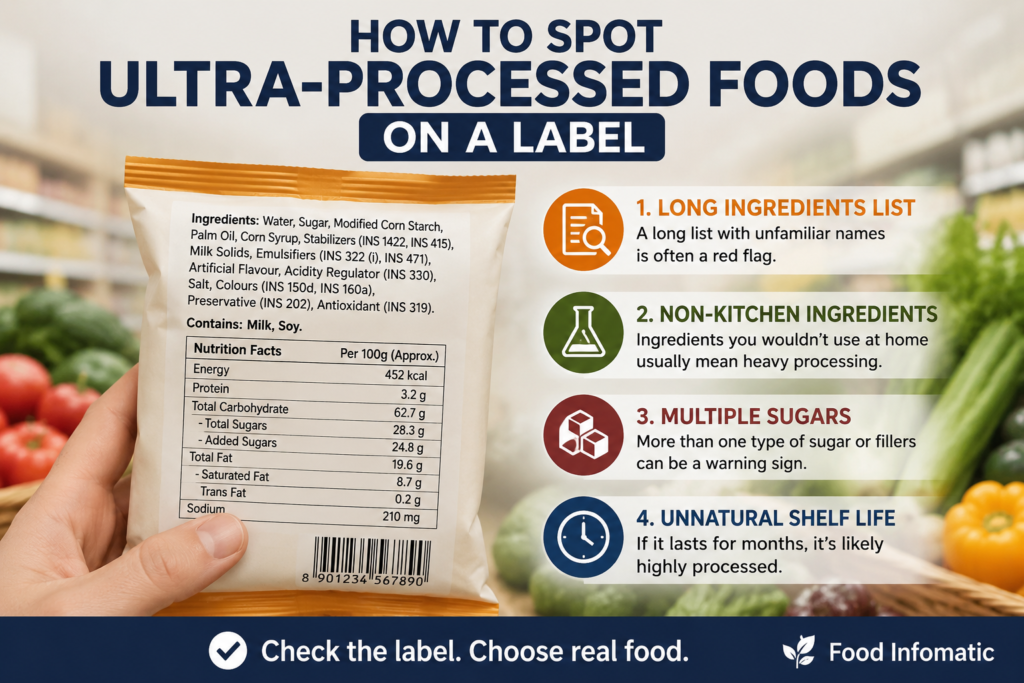
Signal #1: A Long List With Unfamiliar Names
A short ingredients list made up of things you’d recognise from your own kitchen is generally a good sign. A long list filled with names that sound more like a chemistry class than a recipe — emulsifiers, stabilisers, artificial flavourings, or additives with number codes — is a strong indicator of heavy processing.
Signal #2: Ingredients That Don’t Exist in a Home Kitchen
Some ingredients are really only found in industrial food production rather than home cooking — things like hydrogenated oils, protein isolates, or modified starches. If an ingredient sounds like something you’d need a factory rather than a stovetop to produce, that’s usually a sign the product falls further along the processing spectrum.
Signal #3: Multiple Types of Sugar or Fillers
Sometimes sugar shows up more than once on a label, disguised under several different names — syrups, concentrates, or various “-ose” ingredients spread throughout the list rather than appearing as one clear entry. Seeing several sugar-related ingredients scattered across the label, rather than one, is often a sign of heavier formulation.
Signal #4: It’s Designed to Last Far Longer Than the Fresh Version
If a product sits comfortably on a shelf for months without refrigeration, when the “real” version of that food would spoil in days, that shelf stability usually comes from significant processing and preservation methods rather than the food’s natural properties.
A Quick Practical Habit
You don’t need to overhaul your shopping in one go. A simple starting habit is picking one or two categories you buy often — bread, cereal, or snacks, for example — and comparing labels side by side next time you shop. You’ll often be surprised how differently two versions of what looks like the “same” product are actually formulated.
Does “Processed” Always Mean “Bad”?
Not necessarily. Many minimally processed foods — canned beans, frozen vegetables, pasteurised milk — go through some level of processing purely for safety or convenience, without the long list of additives associated with heavier processing. The distinction that tends to matter more for everyday decisions is between light, functional processing and the more extensive industrial formulation associated with ultra-processed products specifically.
Frequently Asked Questions
What’s the easiest way to tell if a food is ultra-processed?
Check the ingredients list first. A long list with unfamiliar, industrial-sounding ingredients is a stronger indicator than anything on the front of the packaging.
Does a long ingredients list always mean a food is unhealthy?
Not automatically, but it’s a reasonable early signal worth investigating further, especially if many of the ingredients aren’t things you’d recognise or use in home cooking.
Is canned or frozen food automatically ultra-processed?
No. Many canned and frozen foods are only minimally processed for preservation or convenience and don’t contain the additive-heavy formulation associated with ultra-processed products.
Why does sugar sometimes appear more than once on a label?
Manufacturers sometimes use multiple sweetening ingredients with different names, which can make total sugar content less obvious at a glance compared to a single clearly listed amount.
Explore More
Interested in more practical food-safety knowledge? Browse our Food Safety category, check out our guide on how much fiber you really need daily, or head back to our homepage for more food facts.