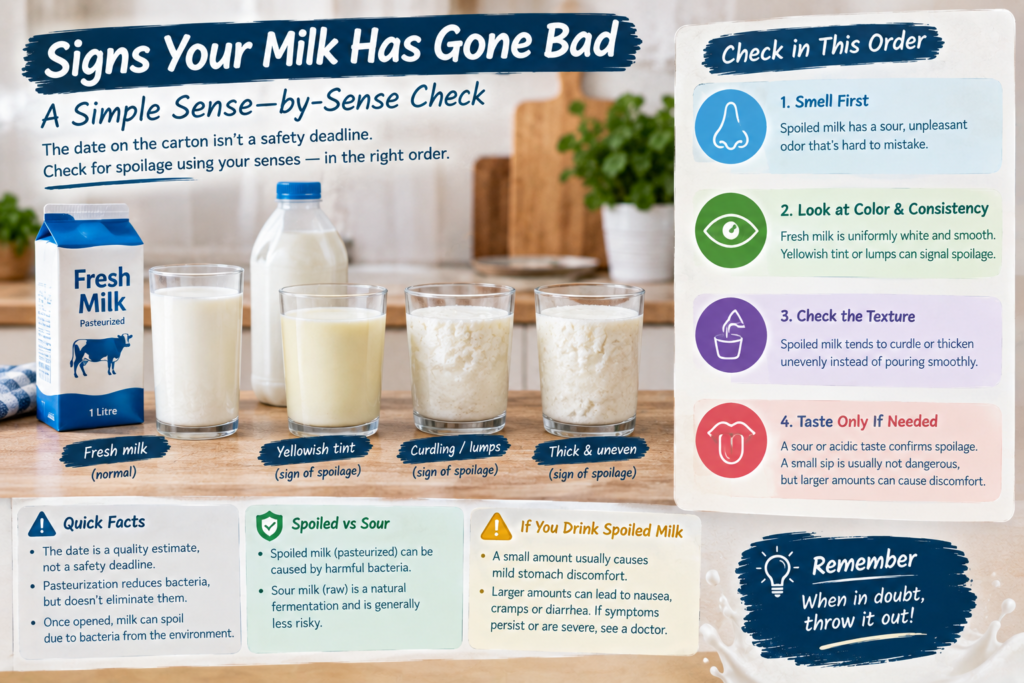
The date printed on a milk carton is a quality estimate, not a safety deadline. Milk can still be fine well past that date if it’s been stored properly, and it can spoil before that date if it hasn’t. The more reliable way to know is to check it yourself, using your senses in a specific order.
Start With Smell
This is usually the fastest and clearest sign. Spoiled milk develops a distinctly sour, unpleasant odor that’s hard to mistake for anything else, caused by bacteria breaking down the milk’s natural sugars. If it smells noticeably off, there’s rarely a need to check anything further.
Then Look at Color and Consistency
Fresh milk should be uniformly white and smooth. A yellowish tint, or any lumps and chunks when poured, generally signals spoilage. Keep in mind that spoiled milk doesn’t always change color dramatically, so this check works best alongside the smell test rather than on its own.
Texture Is the Next Clue
If milk looks slightly off but doesn’t have an obvious color change, checking its texture can help. Spoiled milk tends to curdle or thicken unevenly rather than pouring in a smooth, consistent stream.
Taste Only as a Last Resort
If smell, appearance, and texture all seem fine but you’re still unsure, a small sip is the final check, not the first one. A sour or acidic taste confirms spoilage. It’s worth noting that a small taste of spoiled milk generally isn’t dangerous, though it’s unpleasant enough that most people won’t want to repeat it.
“Spoiled” and “Sour” Aren’t Quite the Same Thing
These terms often get used interchangeably, but there’s a meaningful difference. Spoiled milk usually refers to pasteurized milk that’s gone bad due to bacteria that survived pasteurization or were introduced after opening, which can occasionally include bacteria that pose a genuine health risk. Sour milk more specifically describes raw, unpasteurized milk undergoing natural fermentation from lactic acid bacteria, some of which are similar to what’s used in yogurt or kefir production and generally pose less risk. For store-bought pasteurized milk, “spoiled” is the more accurate term, and it’s safer to treat any questionable batch with caution regardless of which word applies.
Why Pasteurization Doesn’t Prevent Spoilage Forever
Pasteurization reduces harmful bacteria significantly but doesn’t eliminate every microorganism, and once a carton is opened, it’s exposed to bacteria from the environment as well. Over time, these can multiply and cause spoilage regardless of how the milk was initially processed. If you’re curious about how different processing methods affect milk’s shelf life more broadly, our piece on UHT versus pasteurized milk covers that comparison in more depth.
A Practical Safety Note
Drinking a small amount of spoiled milk usually causes nothing worse than an unpleasant taste, but consuming a larger amount can lead to nausea, stomach discomfort, or diarrhea. If you experience persistent or severe symptoms after drinking milk that turned out to be spoiled, it’s worth checking in with a doctor rather than waiting it out.
Questions Worth Asking
Can milk be safe to drink after the date on the carton?
Often, yes, if it’s been stored properly and shows no signs of spoilage. The printed date reflects estimated quality, not a strict safety cutoff.
What’s the very first sign that milk has gone bad?
Smell is usually the clearest and earliest indicator, well before any visible change in color or texture typically shows up.
Is it dangerous to accidentally drink a little spoiled milk?
A small amount is rarely a serious problem, though it can cause mild digestive discomfort. Larger amounts are more likely to cause noticeable symptoms.
Does spoiled milk always look different from fresh milk?
Not always. Some spoiled milk still appears white, which is why relying on smell and taste alongside appearance gives a more reliable picture than looks alone.
For more on how milk is processed and stored, browse our Dairy category, or explore broader food-safety practices in our Food Safety and Quality Management category.