A common assumption behind foods that support collagen production naturally is that eating something high in collagen, like bone broth or chicken skin, directly adds collagen to your own skin or joints. That’s not quite how digestion works. Collagen is a protein, and like any protein you eat, it gets broken down into individual amino acids during digestion. Your body then uses those amino acids, along with a few key supporting nutrients, to build its own collagen from scratch.
This article is for general information only and isn’t intended as medical or dermatological advice. Diet may support the body’s natural collagen production, but it isn’t a treatment for joint conditions or a guaranteed method for changing skin appearance.
The Building Blocks: Amino Acids From Protein
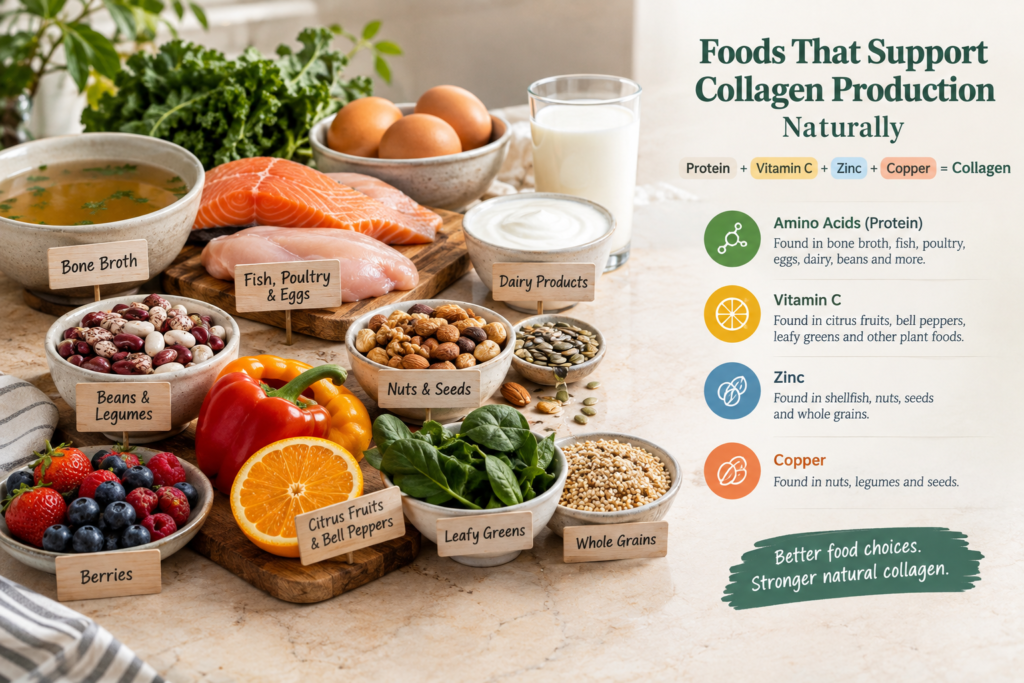
Among the most useful foods that support collagen production naturally are those rich in three specific amino acids: glycine, proline, and lysine. Bone broth, fish, poultry, eggs, dairy, and beans all supply these building blocks. If you’re looking for plant-based protein sources, our guide to refried beans covers how legumes contribute amino acids alongside fiber.
The Cofactors: Why Vitamin C Is Non-Negotiable Here
Having the amino acids available isn’t enough on its own. Your body specifically requires vitamin C to convert those amino acids into stable collagen, a detail we’ve covered in more depth in our guide to foods for knee cartilage health, since the same vitamin C dependency applies to cartilage as it does to skin. Without adequate vitamin C, protein intake alone won’t translate into efficient collagen synthesis. Citrus fruits, bell peppers, and leafy greens are common sources, though plenty of non-citrus options exist too, as covered in our guide to non-citrus vitamin C foods.
Zinc and Copper Play Supporting Roles Too
Beyond vitamin C, zinc and copper are both involved in activating the enzymes responsible for collagen formation. Shellfish, nuts, seeds, and whole grains provide zinc, while nuts and legumes contribute copper. These minerals get far less attention than vitamin C in most collagen-related content, despite playing a genuinely necessary role.
Does Bone Broth Actually Boost Collagen?
Bone broth is often marketed as a direct collagen source, and it does contain collagen extracted from simmered bones and connective tissue. But once consumed, that collagen is digested the same way any other dietary protein is, broken down into amino acids rather than absorbed intact. Bone broth is a reasonable source of the amino acids your body uses for collagen synthesis, but it isn’t fundamentally different from other protein-rich foods in how your body processes it.
Antioxidants Protect What You Already Have
Separate from production, foods rich in antioxidants, including berries, tomatoes, and dark leafy greens, are thought to help protect existing collagen from oxidative damage caused by sun exposure and general aging. This is a protective role rather than a production one, but it’s a meaningful part of the bigger picture.
A Realistic Way to Think About This
Among the most practical foods that support collagen production naturally are simply a varied, protein-adequate diet that includes enough vitamin C, zinc, and copper. This won’t dramatically reverse visible aging, but it gives your body what it needs to maintain its natural collagen production as effectively as possible.
Questions Worth Asking
Does eating collagen directly increase collagen in my skin?
Not directly. Dietary collagen is broken down into amino acids during digestion, and your body uses those amino acids, along with vitamin C, zinc, and copper, to build its own collagen.
Is bone broth actually effective for collagen production?
It provides useful amino acids, but it isn’t absorbed as intact collagen. Its benefit comes from being a protein source, similar in principle to other collagen-supporting foods.
Which nutrient is most important for collagen synthesis?
Vitamin C plays a uniquely essential role, since collagen synthesis can’t proceed efficiently without it, even when amino acids are otherwise available.
Can diet alone significantly change how my skin looks?
Diet supports the body’s underlying collagen production, but it works alongside other factors like sun protection, hydration, and genetics, rather than being a stand-alone solution.