Most advice about eye health focuses on what to add to your plate. Less attention goes to what might be working against you. A handful of food categories are consistently associated with a higher risk of vision problems over time, though the relationship is about long-term risk, not a guarantee that any single food will damage your eyes.
This article is for general information only and isn’t intended as medical advice. If you have diabetes, high blood pressure, or a diagnosed eye condition, it’s worth discussing your specific diet with a doctor rather than relying on general food lists.
Refined Carbohydrates and Added Sugar
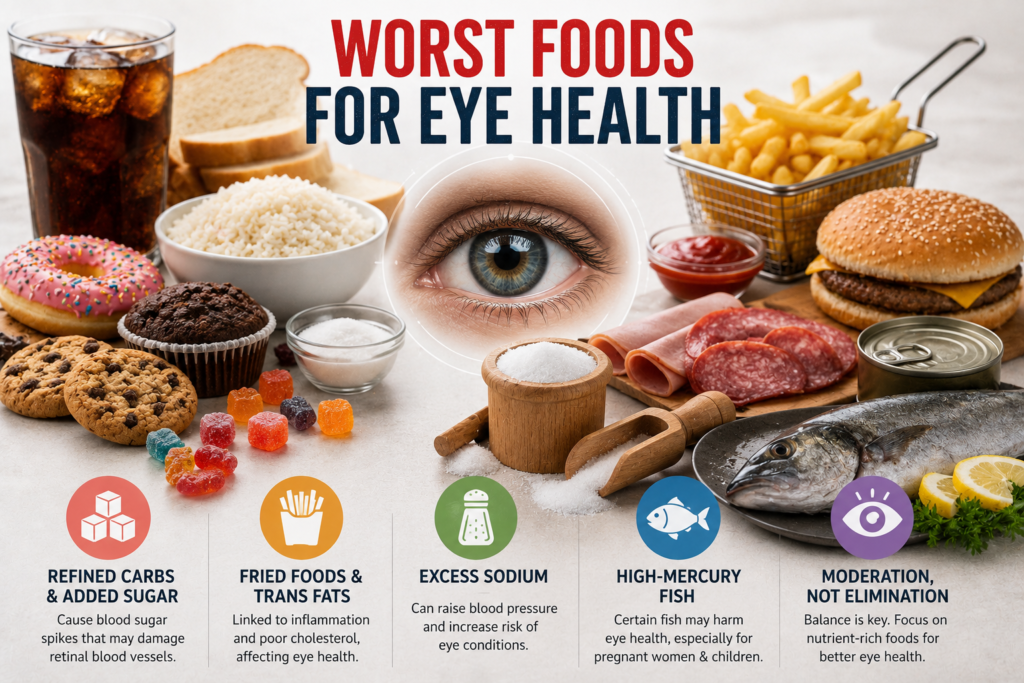
White bread, white rice, and sugary drinks are digested quickly, which causes faster and larger blood sugar swings than slower-digesting whole grains. Over time, frequent blood sugar spikes are associated with a higher risk of damage to the small blood vessels in the retina, including diabetic retinopathy in people with diabetes and, in some research, age-related macular degeneration. This doesn’t mean occasional sugar is dangerous — it’s the pattern of frequent, large spikes that matters more than any single serving. If blood sugar management is a specific concern for you, our piece on fruit juices and diabetes looks at a related piece of that puzzle.
Fried Foods and Trans Fats
Foods made with hydrogenated oils and heavily fried items tend to be high in trans fats, which are generally linked to unfavorable cholesterol patterns and inflammation throughout the body. Since the eyes rely on a dense network of very small blood vessels, this kind of inflammation is thought to affect them more noticeably than larger, more resilient tissues elsewhere.
Excess Sodium
Processed and packaged foods are often the largest source of sodium in a typical diet, more than what’s added at the table. Consistently high sodium intake is associated with elevated blood pressure, which in turn is a recognized risk factor for several eye conditions, including changes to blood vessels in the retina. Checking labels on canned soups, processed meats, and packaged snacks is a practical way to spot hidden sodium.
High-Mercury Fish
This one comes with an important caveat: fish is generally good for eye health, thanks to its omega-3 content. The exception is certain large, long-lived fish species that accumulate higher mercury levels, which is more of a concern for pregnant women, nursing mothers, and young children than for the general adult population. For most people, this isn’t a reason to avoid fish altogether, just a reason to vary the types eaten.
Moderation, Not Elimination
None of this means these foods need to disappear from your diet entirely. The pattern that seems to matter most is frequency and overall balance, not the occasional slice of white bread or fried meal. Pairing this awareness with the food sources covered in our guide to vitamins for eye health gives a more complete picture than focusing on just one side of the equation.
Common Questions
Can diet alone cause vision problems?
Diet is one contributing factor among several, including genetics, age, and overall health conditions like diabetes. It’s rarely the sole cause of an eye condition, but it can meaningfully influence risk over time.
Is sugar really connected to eye health?
Frequent blood sugar spikes are associated with increased risk of certain eye conditions, particularly in people who already have diabetes or prediabetes, though occasional sugar intake isn’t considered a significant standalone risk.
Should everyone avoid high-mercury fish for eye health?
Not necessarily. The concern is mainly relevant for pregnant women, nursing mothers, and young children. Most other adults can eat a variety of fish, including higher-mercury species occasionally, without significant concern.
How much does sodium actually affect vision?
Its effect is indirect — high sodium intake raises blood pressure, and elevated blood pressure is a recognized contributor to several eye conditions over time.