Search for manuka honey and digestive health, and most of what comes up is written by companies selling manuka honey. That’s worth knowing upfront, because it shapes how confidently some of these claims get made. There’s genuine science behind parts of this story, but it’s worth separating what’s well-established from what’s still an open question.
This article is for general information only and isn’t intended as medical advice. Manuka honey isn’t a treatment for ulcers, IBS, colitis, or any other digestive condition, and honey of any kind shouldn’t be given to children under one year old due to a risk of infant botulism. If you’re managing a digestive condition, talk to a doctor rather than relying on honey as a remedy.
What’s Actually Well-Established
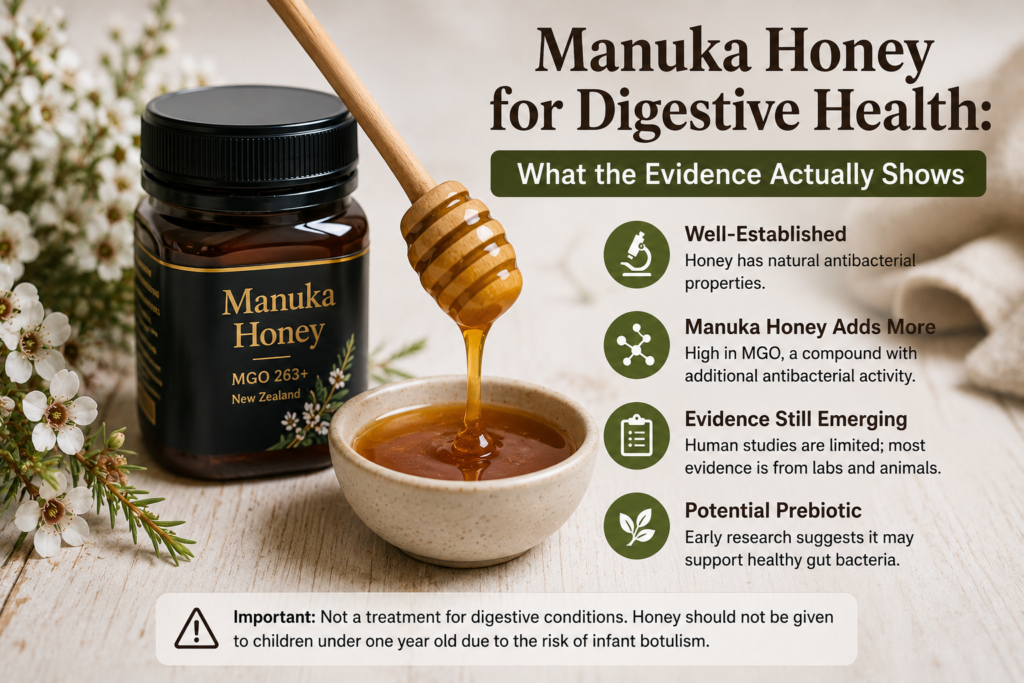
Honey in general has some genuine antibacterial properties, largely due to its low water content and the hydrogen peroxide that forms as enzymes in the honey interact with the environment. This isn’t unique to manuka honey — it’s a property of honey broadly, and it’s one of the reasons honey has a long history of use on wounds and in food preservation.
What Manuka Honey Specifically Adds
Manuka honey contains a compound called methylglyoxal, or MGO, at levels much higher than most other honey types. This gives it an additional antibacterial mechanism that doesn’t rely on hydrogen peroxide, which is part of why manuka honey is graded and sold based on its MGO or UMF rating. This part of the story is reasonably well documented at the laboratory level — MGO does measurably inhibit certain bacteria in test-tube conditions.
Where the Evidence Gets Thinner
This is where a lot of marketing claims outrun the actual research. Claims about manuka honey healing ulcers, calming IBS, or reducing colitis symptoms are based mainly on animal studies and lab experiments, not established human clinical trials. Some small feasibility studies in humans are currently underway, which is a sign that researchers see it as worth investigating, but it also means the human evidence isn’t there yet. Treating manuka honey as a proven remedy for any digestive condition goes further than what’s currently been demonstrated.
The Prebiotic Angle
There’s also interest in honey’s potential prebiotic effect — the idea that it might feed beneficial gut bacteria. Early lab studies looking at this are promising, but this is another area where “shows potential in lab conditions” is different from “proven to work once you eat it.”
A Practical Way to Think About It
It’s reasonable to enjoy manuka honey as a slightly different, well-studied type of honey with some interesting antibacterial chemistry — without expecting it to resolve a digestive condition. If you have ongoing digestive symptoms, a food-based approach worth exploring first is fiber intake, which we cover in more depth in our guide to fiber and digestion.
An Important Safety Note
Honey of any kind, including manuka, can contain bacterial spores that are dangerous for infants under one year old, leading to a rare but serious condition called infant botulism. This is a standard food-safety guideline covered in more depth in our Food Safety and Quality Management category, and it applies regardless of how “natural” or premium a honey product is marketed as being.
Questions Worth Asking
Does manuka honey actually cure stomach ulcers?
No solid human evidence supports this. Some animal studies suggest possible benefits, but that’s a long way from a proven treatment, and ulcers require proper medical evaluation and care.
Is manuka honey better than regular honey for gut health?
It has a higher concentration of one specific antibacterial compound, MGO, but regular honey shares many of the same general antibacterial properties. The difference is one of degree, not a completely different category of benefit.
Why do MGO or UMF ratings matter?
These ratings measure the concentration of manuka honey’s specific antibacterial compounds and help verify authenticity, since manuka honey is sometimes diluted or mislabeled. They aren’t a guarantee of any particular health outcome.
Can babies have manuka honey?
No. Honey of any kind, manuka included, shouldn’t be given to children under one year old because of the risk of infant botulism.