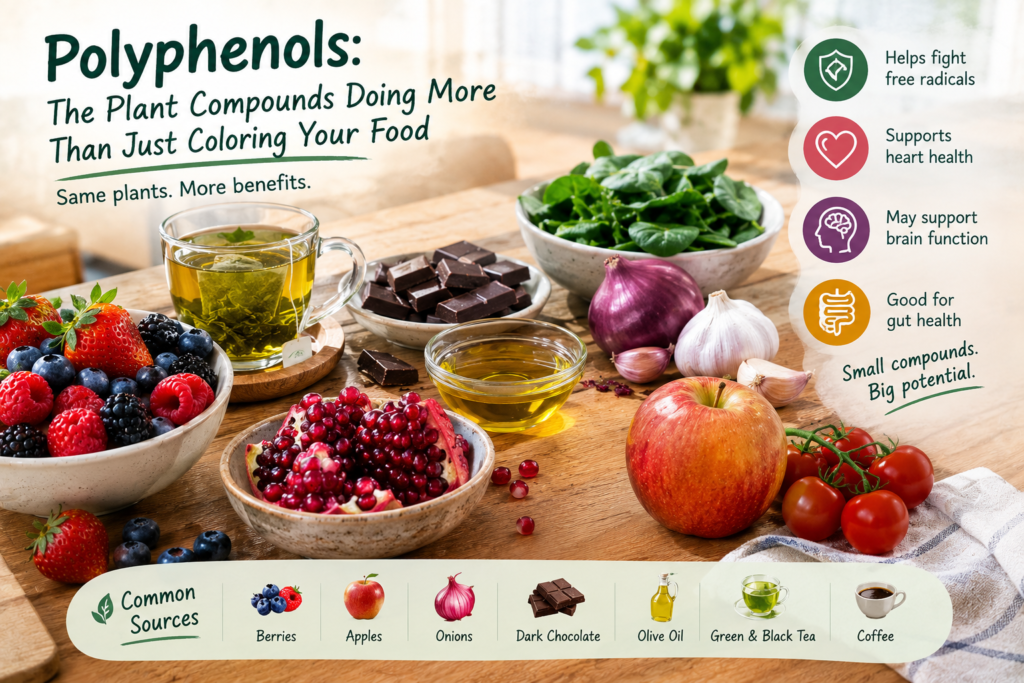
Berries, dark chocolate, and green tea keep showing up on “superfood” lists for the same reason — they’re rich in polyphenols, a group of natural compounds plants make to protect themselves from sun damage and pests.
This article is for general informational purposes and isn’t medical advice. Polyphenols are a normal part of a varied diet, not a treatment for any condition.
Once eaten, these compounds are thought to act as antioxidants in the body, helping neutralize unstable molecules called free radicals. They don’t work alone — a diet with variety matters more than any single “polyphenol food.”
Where Polyphenols Actually Come From
Polyphenols aren’t one single nutrient — they’re a large family of compounds, including flavonoids and tannins, found across thousands of plants. That’s why the color of a fruit or vegetable is often a rough clue: the same pigments that give berries their deep purple or green tea its color are frequently polyphenol-related.
Common sources include berries, apples, onions, dark chocolate, olive oil, green and black tea, and coffee. Cooking method and ripeness affect the amount, so two servings of the “same” food don’t always contain the same level.
Raw vs Cooked: Does It Change Anything?
For some vegetables, light cooking can actually make certain polyphenols easier for the body to access, while for others, raw is better because heat breaks the compounds down. Onions and garlic, for example, tend to lose some benefit with prolonged high heat, while tomatoes are a case where cooking can help. There’s no single rule that applies to every food.
Pairing Matters More Than People Realize
Some polyphenols are fat-soluble, meaning they’re absorbed better when eaten alongside a small amount of fat — a drizzle of olive oil on vegetables, or nuts alongside berries, rather than the fruit or vegetable alone.
A Simple Way to Add More
Instead of tracking specific compounds, a practical approach is to eat a wide variety of colorful fruits and vegetables through the week, include tea or coffee if already part of the routine, and choose dark chocolate with a higher cocoa content over milk chocolate when having a treat. Pomegranates are a good example of a fruit that’s naturally high in these compounds — our piece on eating pomegranate seeds looks at how to actually get the most out of one.
Common Questions
Are polyphenol supplements as good as eating the actual food?
Whole foods generally offer a broader mix of compounds plus fiber and other nutrients that a supplement isolates away from; food sources are usually the more reliable choice.
Does dark chocolate really count as a health food?
In moderate amounts, dark chocolate with a higher cocoa percentage does contain polyphenols, but it’s still calorie-dense, so portion size matters.
Is green tea better than black tea for this?
Both contain polyphenols, just different types — green tea has more catechins, black tea has more theaflavins from the fermentation process.
Do polyphenols lose their value once the food is frozen?
Freezing tends to preserve most of the compounds reasonably well, often better than long storage at room temperature.
Olive oil is one of the more consistent polyphenol sources in a daily diet — our guide on choosing the healthiest cooking oil goes into why olive oil tends to come out ahead of more processed options.