Drinking water isn’t the only way the body gets its daily fluid — a meaningful portion of it, for most people, actually comes from food.
This article is for general informational purposes and isn’t medical advice.
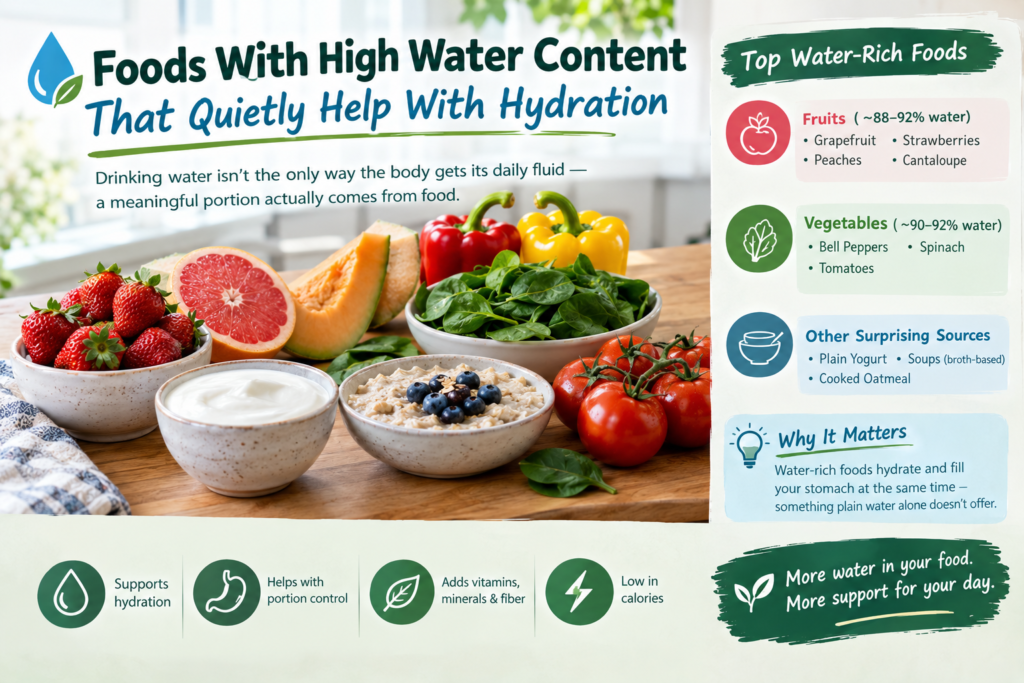
Fruits and vegetables in particular can be over 90% water by weight, which means a serving of the right ones contributes more to daily hydration than their size might suggest.
Fruits With the Highest Water Content
Grapefruit and strawberries both sit in the high 80s to low 90s percent range for water content, and both are also naturally rich in vitamin C, which adds nutritional value beyond just fluid. Peaches and cantaloupe fall in a similar range and work well sliced into a midday snack when something cold and refreshing is needed.
Vegetables With the Highest Water Content
Bell peppers are often overlooked here, sitting at around 92% water while also being genuinely rich in vitamin C — more per gram than an orange, in fact. Spinach and tomatoes are two other everyday options that carry significant water content while adding color and nutrients to a plate without much bulk in calories.
Sources People Don’t Expect
Plain yogurt, soups made with a broth base, and cooked oatmeal all carry more water than their solid appearance suggests, since the water is absorbed into the food rather than sitting separately. This is one reason a bowl of soup can feel more hydrating than a similarly sized plate of dry food.
Why This Matters Beyond Just Thirst
Water-rich foods hydrate and fill the stomach at the same time, which is a combination plain drinking water alone doesn’t offer. This is part of why a diet built around these foods tends to naturally support both hydration and portion control without extra effort.
A Simple Way to Use This
Starting a meal with a water-rich food — sliced bell pepper, a tomato-based soup, or a bowl of grapefruit — is a practical way to add hydration and volume before the more calorie-dense parts of a meal. Our piece on high-volume, low-calorie foods covers a related but distinct principle — fullness through energy density rather than hydration specifically, using a largely different set of examples.
Common Questions
Can eating water-rich foods actually replace drinking water?
Not entirely — food generally covers a meaningful portion of daily fluid needs, but drinking water directly is still necessary to fully meet typical daily requirements.
Does cooking reduce the water content of vegetables?
It depends on the method — boiling can leach some water-soluble nutrients out, while steaming or roasting tends to preserve more of both water and nutrient content.
Are water-rich foods less nutritious because they’re mostly water?
No — many of them, like bell peppers and spinach, are also dense in vitamins, minerals, and fiber relative to their calorie content.
Is frozen fruit still high in water content?
Generally, yes — freezing doesn’t remove water from fruit, though texture changes once thawed compared to fresh.