What lands in your stomach before you train affects how the session actually feels. What you eat afterward affects how quickly your body bounces back. Both matter, but they’re solving different problems, which is why the advice for each end of a workout looks quite different.
This article is for general information only and isn’t medical advice. Speak with a doctor or dietitian for guidance specific to your training or health needs.
Before Training: Fuel, Not a Full Meal
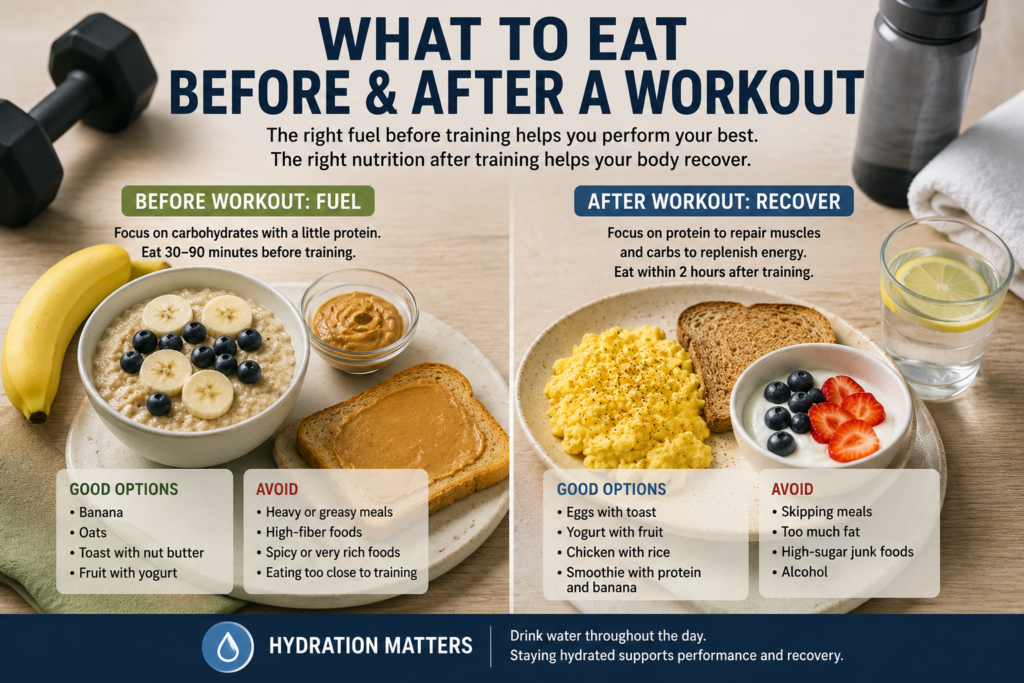
The body relies heavily on stored carbohydrate, known as glycogen, to power moderate-to-high intensity exercise. Eating something carbohydrate-based beforehand helps top up that supply rather than starting a session already running low.
A small amount of protein alongside it can help too, particularly for strength-focused training, though the pre-workout meal doesn’t need to be large or complicated. Timing matters more than complexity — eating too close to training can leave you feeling heavy or uncomfortable, so allowing some buffer time before starting usually works better than eating right at the door.
Practical pre-workout options include a banana, a small bowl of oats, or a slice of toast with a thin spread of nut butter — simple, carbohydrate-forward choices that digest without much fuss.
After Training: Repair and Replenish
Once a session ends, the priorities shift. Muscle tissue needs protein to support repair, a process called protein synthesis, while glycogen stores that were used up during exercise need carbohydrates to refill.
Eating a balanced combination of both within a reasonable window after finishing — generally within a couple of hours — tends to support recovery better than skipping food or waiting an extended period. There’s no need to treat this as an urgent countdown; consistency across your overall diet matters more than hitting an exact minute mark.
Reasonable post-workout choices include eggs with toast, a yoghurt with fruit, or a simple meal built around a protein source and a carbohydrate side.
Don’t Overlook Hydration
Fluid loss through sweat affects performance and recovery just as much as food does, yet it’s often the first thing people forget. Drinking water consistently throughout the day, not just during the workout itself, tends to matter more than trying to rehydrate all at once afterward.
What to Generally Avoid Beforehand
Heavy, greasy, or very high-fiber meals shortly before training can sit uncomfortably and are a common cause of mid-workout discomfort. Saving those foods for later in the day, rather than right before exercise, tends to make training feel more comfortable.
Common Questions
What should I eat 30 minutes before a workout?
Something light and carbohydrate-based works best this close to training, such as a piece of fruit, since heavier meals need more time to digest comfortably.
Is it bad to work out on an empty stomach?
For shorter or lower-intensity sessions, many people manage fine without eating first. For longer or more intense training, having some fuel beforehand generally supports better performance.
How soon after a workout should I eat?
Eating within a couple of hours after training is a reasonable general guideline, though there’s no strict cutoff that makes recovery ineffective if it happens slightly later.
Do I need a protein shake after every workout?
Not necessarily. A shake is simply a convenient way to get protein in — whole food sources work just as well if that’s more practical for you.
Muscle recovery and everyday movement are closely connected — our guide on eating for sustained energy covers a related angle if irregular schedules affect your training too.