The name suggests it’s about how long something takes to cook, but the slow food movement is really about where food comes from and how it’s made — not the minutes on a timer.
This article is for general informational purposes and describes a food philosophy, not medical or dietary guidance.
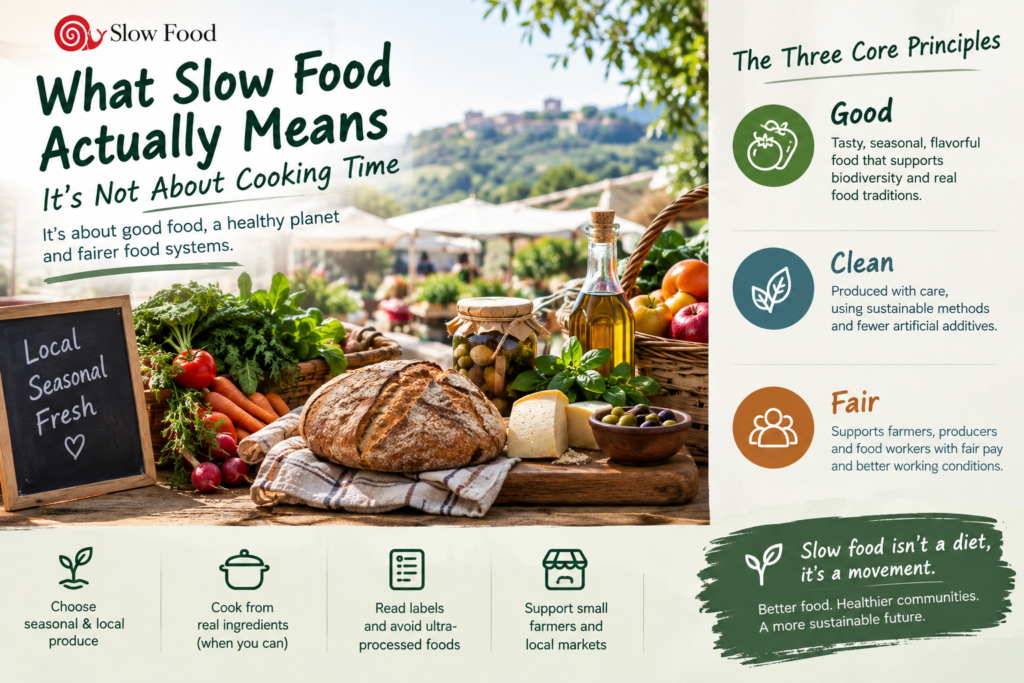
Slow food started in Italy in the late 1980s as a response to the spread of fast food, and it’s built around three connected ideas: good, clean, and fair food.
Good: Food That Actually Tastes Like Something
This refers to fresh, seasonal, flavorful food — the opposite of a lot of mass-produced food that’s engineered mainly for shelf life and consistency rather than taste. A tomato grown in season and picked ripe, for example, tastes noticeably different from one picked green and gassed to ripen during shipping, which is common with produce that travels long distances.
The “good” principle also ties into biodiversity — favoring older, regional fruit and vegetable varieties instead of the handful of commercial varieties bred mainly for uniform size and long shelf life, even when flavor is traded off in the process.
Clean: Made Without Cutting Corners
This part focuses on production methods that don’t harm the environment or rely heavily on artificial additives. It’s less about “organic” as a label and more about food produced with care rather than volume as the only goal. A good real-world example of this idea in practice is traditional fermentation — our piece on the science of sourdough fermentation looks at a process that’s slow almost by definition.
Fair: Fair to the People Who Grow and Make It
This is the part most people miss — slow food isn’t only about the eater’s experience; it also includes fair pay and working conditions for farmers, producers, and food workers along the chain. In practice, this often shows up as support for small farmer cooperatives, fair-trade certified products, or buying directly from local producers rather than through long, opaque supply chains where it’s harder to know how workers were treated or paid.
This principle is part of why slow food is described as a movement rather than just a diet — it’s as much about the systems behind food as the food itself.
How This Shows Up in Everyday Choices
Practically, it looks like buying from a local market instead of only packaged aisles, cooking a meal from raw ingredients occasionally instead of a ready-made one, or simply reading a label to understand what’s actually in a product. Our guide on spotting ultra-processed foods on a label is a useful starting point for the “clean” part of that in practice.
You Don’t Have to Overhaul Everything
One realistic way to start is picking one meal a week to cook from scratch with seasonal ingredients, rather than trying to convert an entire diet overnight.
Common Questions
Is slow food the same as organic food?
Not exactly — organic refers to a specific certification standard, while slow food is a broader philosophy about quality, environment, and fairness that doesn’t require certification.
Does slow food mean avoiding all convenience foods?
No — it’s more of a general direction than a strict rule, and most people who follow it still use some convenience foods some of the time.
Is slow food more expensive?
It can be, particularly for specialty or artisanal products, though buying seasonal and local produce directly can sometimes cost less than packaged alternatives.
Where did the slow food movement actually start?
It began in Italy in 1986, originally as a protest against a fast food restaurant opening near a historic landmark in Rome.