
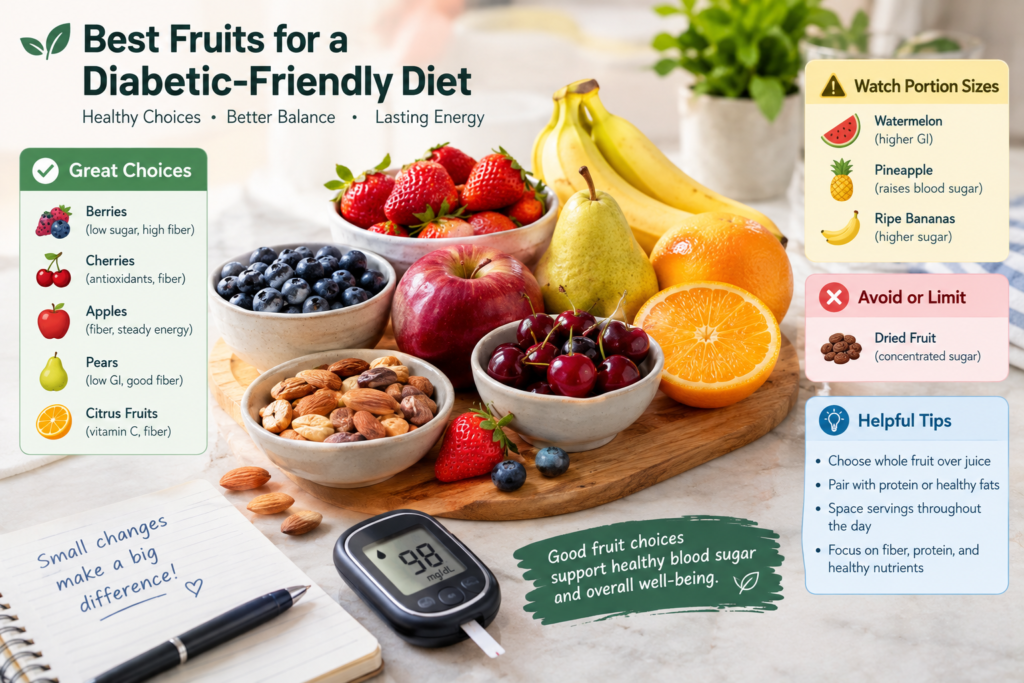
When it comes to the best fruits for a diabetic-friendly diet, there’s a common fear that fruit is simply too sugary to include. Most nutrition guidance actually points the other way. Whole fruit, eaten with attention to portion and pairing, is generally considered a beneficial part of a diabetes-friendly diet, not something to avoid.
This article is for general information only and isn’t intended as medical advice. If you’re managing diabetes, it’s worth working with a doctor or dietitian to fit fruit into your specific meal plan, since individual blood sugar responses vary.
Glycemic Index Isn’t the Whole Picture
The glycemic index (GI) ranks how quickly a food raises blood sugar, but it’s measured using a fixed amount of carbohydrate, not a realistic serving size. This is where glycemic load (GL) becomes more useful, since it factors in actual portion size alongside the GI value. A fruit with a moderately high GI eaten in a small portion may have a fairly low glycemic load overall, which is part of why rigidly avoiding “high GI” fruits can be more restrictive than necessary when building a diabetic-friendly diet.
What Makes a Fruit Choice Diabetic-Friendly
Berries, cherries, apples, pears, and citrus fruits are commonly cited among the best fruits for a diabetic-friendly diet, largely due to their fiber content and lower sugar concentration relative to their size.
Fruits That Deserve More Portion Awareness
Watermelon, pineapple, and very ripe bananas tend to raise blood sugar more quickly per serving, but this doesn’t mean avoiding them entirely, it means being more mindful of how much you eat at once.
Why Whole Fruit Behaves Differently From Juice
Whole fruit delivers its natural sugar wrapped in fiber, which slows digestion and smooths out the resulting blood sugar rise. Juice strips away most of that fiber, allowing sugar to enter the bloodstream much faster for a comparable amount of fruit. We cover this distinction in more depth in our guide to fruit juices and diabetes, which looks at the juice side of this same question.
A Note on Dried Fruit
Dried fruit concentrates both sugar and calories into a much smaller volume than the fresh version, meaning a small handful can carry as much sugar as a full serving of fresh fruit. This is worth keeping in mind rather than treating dried and fresh fruit as interchangeable, something our dried mango nutrition guide touches on from a different angle.
Practical Ways to Build a Diabetic-Friendly Diet Around Fruit
Pairing fruit with a source of protein or healthy fat, like nuts or plain yogurt, tends to blunt the blood sugar response further. Spacing fruit servings throughout the day, rather than eating several servings at once, also tends to produce steadier results. Our guide to fiber and digestion covers more on how fiber interacts with blood sugar response generally.
What Fruit Can’t Do
No fruit, or combination of fruits, reverses diabetes on its own. Fruit is a supportive part of an overall eating pattern, not a treatment, and it works alongside other factors like overall diet quality, activity, and medical management.
Questions Worth Asking
Should people with diabetes avoid high-glycemic fruits completely?
Not necessarily. Portion size matters as much as the glycemic index value itself, so smaller servings of higher-GI fruits can still fit into a balanced approach.
Is fresh fruit always better than dried fruit for blood sugar?
Generally, yes, since dried fruit concentrates sugar into a smaller volume, making it easier to consume more sugar than intended in a small serving.
Does pairing fruit with protein actually help blood sugar?
It’s generally considered helpful, since protein and fat slow digestion and can smooth out the blood sugar response compared to eating fruit alone.
Can eating more fruit reverse diabetes?
No single food reverses diabetes. Fruit can be a supportive part of a diabetic-friendly diet, but it works alongside broader dietary and medical management, not as a stand-alone fix.