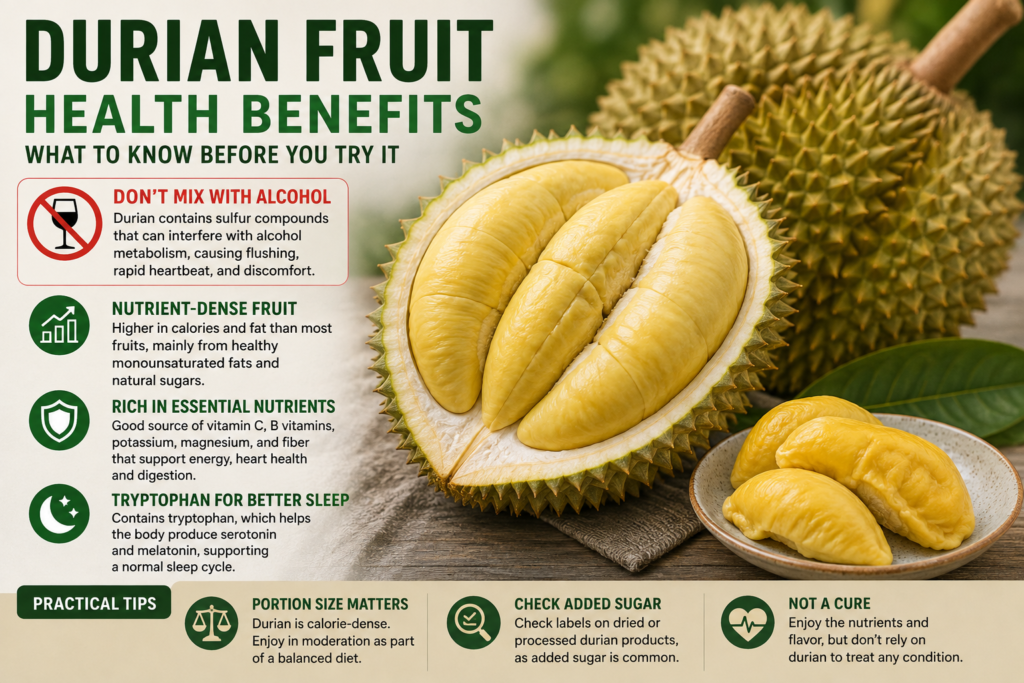
Before getting into durian fruit health benefits, there’s one practical thing worth knowing first: durian and alcohol don’t mix well. The fruit contains sulfur compounds that interfere with how the body breaks down alcohol, which can lead to flushing, a rapid heartbeat, and general discomfort if the two are consumed close together. It’s a genuinely useful thing to know before diving into what is otherwise a nutrient-dense, distinctive fruit.
This article is for general information only and isn’t intended as medical advice. If you have a heart condition, are managing your calorie or sugar intake closely, or are taking medication that affects alcohol metabolism, it’s worth checking with a doctor before eating durian regularly.
What Makes Durian Nutritionally Different From Most Fruits
Durian stands out among fruits mainly because of its fat content and calorie density. Most fruits are relatively low in calories, largely due to their water content, but durian is a notable exception — it’s considerably more calorie-dense, largely from monounsaturated fat, alongside its natural sugars. This isn’t a flaw, just a different nutritional profile that’s worth factoring in if you’re tracking intake closely.
The Nutrients It Does Bring
Durian carries a genuinely broad nutrient profile: vitamin C, several B vitamins, potassium, magnesium, and a meaningful amount of fiber. Potassium and magnesium in particular are associated with normal blood pressure regulation, and the B-vitamin content supports general energy metabolism. None of this makes durian a cure for anything, but as part of a varied diet, it contributes real, useful nutrients.
The Tryptophan and Sleep Connection
Durian also contains tryptophan, an amino acid the body uses as a building block for serotonin and, eventually, melatonin. This is often stretched into claims that durian “cures insomnia,” which goes further than the evidence supports. Tryptophan-containing foods are generally considered supportive of a normal sleep cycle, but that’s a modest, supporting role rather than a treatment for a sleep disorder.
Separating the Real Benefits From the Overreach
A lot of the more dramatic claims circulating about durian — that it prevents cancer, acts as an aphrodisiac, or reverses heart disease — go well beyond what current research actually supports. Some laboratory and animal studies have looked at durian’s antioxidant compounds with interesting early results, but that’s a long way from proven effects in people. It’s reasonable to treat durian as a nutrient-rich, calorie-dense fruit worth enjoying in moderation, not a substitute for medical treatment of any condition.
Practical Notes Before You Eat It
Given its calorie density, portion size matters more with durian than with most fruits. It’s also worth checking labels on dried or processed durian products, since added sugar is common and can offset some of the fruit’s natural nutritional value.
Questions People Ask About Durian
Is it actually dangerous to drink alcohol after eating durian?
It can cause uncomfortable symptoms like flushing and a rapid heartbeat due to how durian’s sulfur compounds interfere with alcohol metabolism. It’s generally recommended to avoid combining the two.
Why is durian higher in calories than other fruits?
Its calorie density comes mainly from its fat content, which is unusually high for a fruit and part of what gives durian its rich, custard-like texture.
Does durian really help you sleep better?
It contains tryptophan, which plays a supporting role in the body’s sleep-related processes, but it isn’t a proven treatment for insomnia or sleep disorders.
Is durian safe to eat every day?
Given its calorie density, eating it occasionally as part of a varied diet is a more reasonable approach than making it a daily staple, particularly for anyone watching calorie or fat intake.
Fruit timing and pairing questions like this come up a lot — our team recently looked at whether when you eat fruit actually matters, which touches on some of the same digestion-related questions.