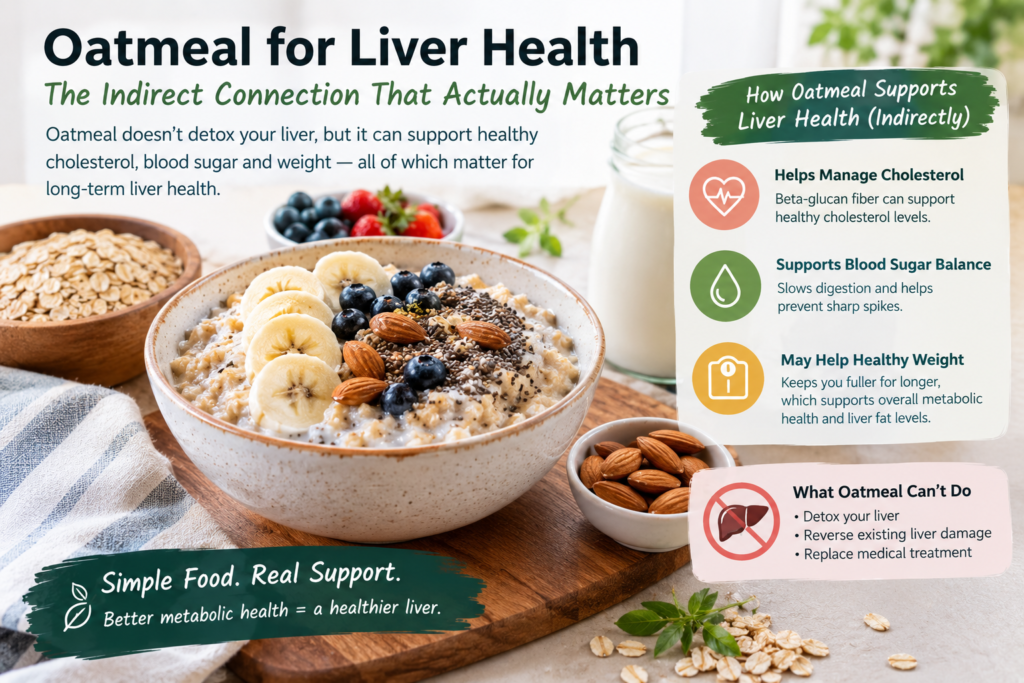
Oatmeal doesn’t detox your liver, and it’s worth saying that plainly upfront, since a lot of content around this topic implies otherwise. Your liver already handles detoxification on its own. What oatmeal can realistically do is support a few metabolic factors that influence how much fat tends to accumulate in liver tissue over time, which is a more accurate, if less dramatic, story.
This article is for general information only and isn’t intended as medical advice. If you have a diagnosed liver condition, including fatty liver disease, proper management requires a doctor’s guidance, bloodwork, and monitoring, not just dietary changes on their own.
The Indirect Path: Fiber, Cholesterol, and Blood Sugar
Oats contain beta-glucan, a soluble fiber that’s fairly well documented for helping manage cholesterol levels and supporting steadier blood sugar response after meals. These two factors, cholesterol and blood sugar regulation, are closely tied to how much fat the liver stores over time. This is the actual mechanism at play, an indirect one, rather than oats acting on the liver directly.
Why “Liver Detox” Framing Is Misleading
The liver is the organ responsible for filtering and processing toxins in the first place. No food, oatmeal included, “detoxes” it in the way that phrase implies. What diet can influence is the liver’s workload, mainly through managing weight, blood sugar, and fat intake, which is a meaningfully different claim than a food actively cleansing an organ.
What This Looks Like in Practice
A bowl of plain oats, rather than a heavily sweetened instant packet, contributes fiber without much added sugar working against the same goal. Pairing oats with fruit or nuts rather than syrup or brown sugar keeps this balance intact. This distinction, whole oats versus processed oat products, comes up consistently across nutrition sources discussing this topic.
What Oatmeal Can’t Do
It can’t reverse existing liver damage, and it isn’t a substitute for medical evaluation if you have a diagnosed liver condition. Diet is one supporting factor among several, alongside weight management, physical activity, and, where relevant, medical treatment guided by a doctor.
A Reasonable Way to Think About This
Including oats as part of a fiber-rich, whole-food diet is a reasonable, low-risk choice that supports several metabolic factors relevant to liver health, without needing to believe it’s doing anything more dramatic than that. For a broader look at what oats offer nutritionally, our guide to oats and health benefits covers the full picture beyond this specific angle.
Questions Worth Asking
Does oatmeal actually detox the liver?
No. The liver handles detoxification on its own. Oatmeal’s role is limited to supporting metabolic factors like cholesterol and blood sugar, which indirectly relate to liver fat accumulation.
Can oatmeal reverse fatty liver disease?
No single food reverses a diagnosed condition. Oatmeal may support a liver-friendly eating pattern, but managing fatty liver disease requires proper medical guidance.
Is instant oatmeal as good as plain oats for this purpose?
Generally not as good, since many instant varieties contain significant added sugar, which works against the same metabolic factors oats are otherwise helpful for.
What else supports liver health besides diet?
Maintaining a healthy weight, regular physical activity, limiting alcohol, and following medical guidance for any diagnosed condition all play a larger role than any single food.