Nutrition labels pack a lot of information into a small box, and most people either skim past it entirely or focus on just one number without knowing whether it actually matters.
This article is for general informational purposes and isn’t medical advice. It focuses specifically on the nutrition facts panel and its numbers; our guide on spotting ultra-processed foods on a label covers the ingredient list side of label-reading instead.
The nutrition facts panel follows a fairly standard format, and once the order makes sense, reading it takes a few seconds rather than a few minutes.
Start With the Serving Size
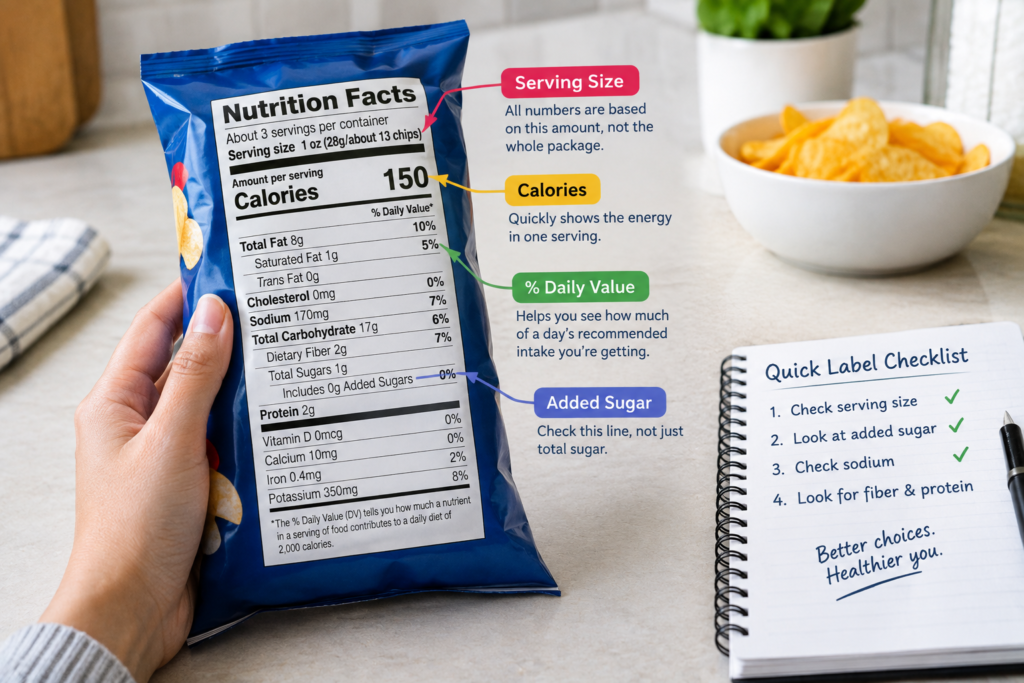
Every number on the label is based on the serving size listed at the top, not the whole package. A bag that looks like one portion but lists “3 servings” means the calories and other numbers need to be multiplied by three for the full bag.
Look at Percent Daily Value, Not Just the Raw Number
The %DV column shows how much of a day’s recommended intake one serving provides, based on a general reference diet. As a rough guide, 5% or less is considered low for that nutrient, and 20% or more is considered high — useful for quickly judging sodium or saturated fat without doing math.
Check Added Sugar, Not Just “Sugar”
Total sugar includes naturally occurring sugar (like in fruit or milk) along with anything added during processing. The “added sugars” line, listed separately, is generally the more useful number to watch, since naturally occurring sugar comes with other nutrients attached.
Sodium Adds Up Faster Than It Looks
A single serving might look moderate, but sodium accumulates quickly across a day of packaged foods. Checking the %DV for sodium across a few items eaten in a day gives a more realistic picture than looking at one label in isolation.
Fiber and Protein: The Numbers Worth Looking For
Unlike sugar or sodium, fiber and protein are generally worth looking for more of, not less. Comparing two similar products side by side on these two lines alone often reveals a meaningfully better option.
A Quick Way to Scan Any Label
Check the serving size first, then added sugar, sodium, and fiber in that order — this covers the numbers most relevant to everyday health decisions in under ten seconds, without reading every line on the panel.
Common Questions
Does a “0g trans fat” label always mean there’s truly none?
Not always — labeling rules allow rounding down to zero for amounts under half a gram per serving, so checking the ingredient list for partially hydrogenated oils is a more reliable check.
Is a lower-calorie product automatically the healthier choice?
Not necessarily — a lower-calorie option can still be high in sodium or added sugar, so it’s worth checking those lines too rather than calories alone.
Why do some labels list “per serving” and others “per 100g”?
It depends on the region and product type; per-100g figures are useful for comparing two products directly, regardless of their different serving sizes.
What’s the difference between the nutrition label and the ingredient list?
The nutrition label shows quantities of specific nutrients, while the ingredient list shows what the product is actually made of, in descending order by weight.